Optimizely hack: crypto-stealing code ran on 178 websites, including Ledger, HSBC, the BBC and Zoom. What happened, who was affected, and how to check an address before you send
Optimizely hack: on 16 November 2026 an attacker used Optimizely, a website testing service that many large companies load on every page, to plant code that swapped crypto wallet addresses on the sites of 178 organisations, including Ledger, HSBC, the BBC and Zoom, according to security firm Report URI. The companies' own servers were not broken into: the code arrived through Optimizely's script. Optimizely told reporters an attacker "exploited a vulnerability in the Experimentation account signup flow" and said it has fixed the flaw and removed the code. Report URI found the last infected script cleaned at 23:11 UTC the same day. Wallets linked to the attack received about $2,300 to $7,150 depending on who is counting; no company has reported a figure. This article sets out what happened, how address-swapping code works, who was affected and a checklist for checking an address before you send. All times are UTC.
 NO KYCSign up to BloFin
 Sign up to Bybit
 Sign up to OKX
 Sign up to Bitget
 Sign up to MEXC
 Sign up to OrangeX
 Sign up to Toobit
What happened in the Optimizely hack
The key moments, with times in UTC:
| Time (UTC) | What happened | Source |
|---|---|---|
| 13 to 16 Nov | An earlier wave of similar code spreads through three other web services | Hudson Rock via CoinDesk, Report URI |
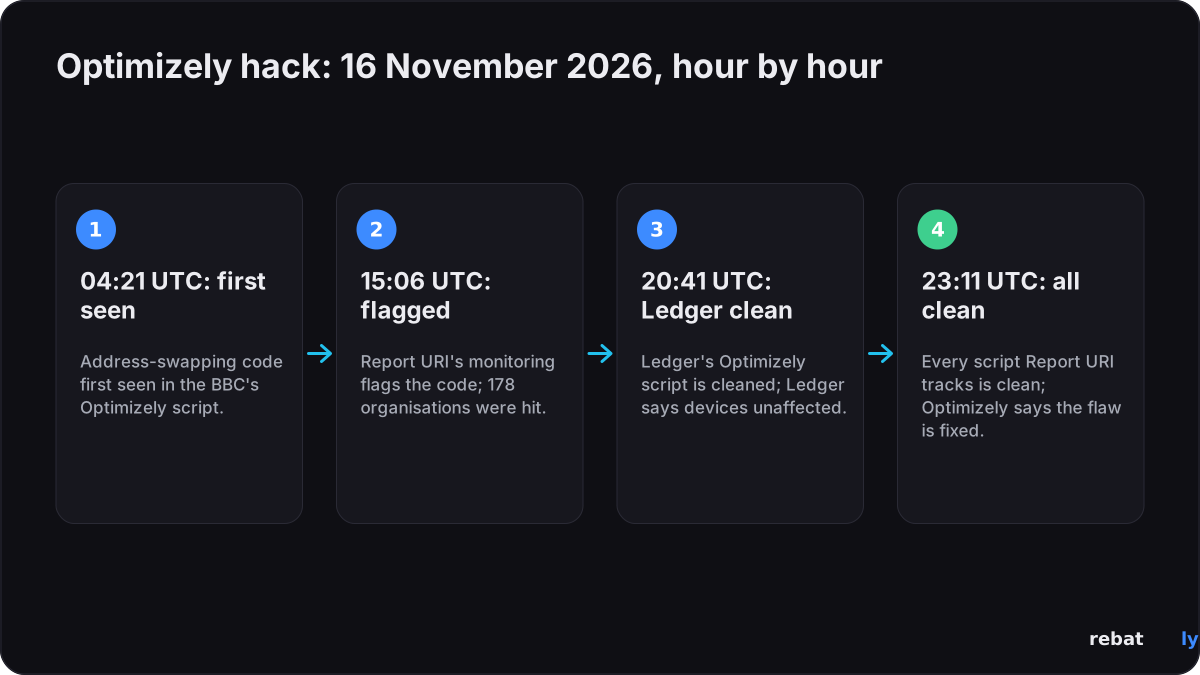
| 16 Nov, 04:21 | The first injected Optimizely script is seen, on the BBC's website | Report URI, Cointelegraph, SecurityWeek |
| 16 Nov, 13:43 | Card-skimming code is added to the script | Report URI |
| 16 Nov, 15:06 | Report URI's monitoring flags malicious code on a customer's site | Scott Helme |
| 16 Nov, 19:25 | Wallets linked to the attack have received about $7,040 | Report URI, CoinDesk |
| 16 Nov, 20:41 | Ledger's Optimizely script is cleaned | Report URI, Cointelegraph |
| 16 Nov, 21:52 | Only one of 188 infected scripts still carries the code | Report URI, BleepingComputer, SecurityWeek |
| 16 Nov, 23:11 | Every script Report URI tracks is clean | Report URI |
| 17 Nov, 01:02 | Optimizely's status page confirms the incident and says the flaw is fixed | Optimizely |
| 17 Nov | Ledger says the code is no longer served on its website and its devices are not affected | Ledger via U.Today |
Optimizely puts its first malicious change at 07:51 on 16 November, CSO Online reported, without giving a time zone; Report URI's 04:21 UTC comes from saved copies of the BBC's page. On Report URI's times, the code was live for about 19 hours in total and about 16 hours on Ledger's site. StepSecurity, another security firm, put it at about 16 hours for most sites.
How the Optimizely hack happened
Optimizely runs A/B tests: a site adds one Optimizely script, and every visitor's browser then runs whatever code the site's Optimizely project contains. Optimizely told Cointelegraph and other outlets that an unauthorized party "exploited a vulnerability in the Experimentation account signup flow" and used it to add malicious JavaScript to some customer projects. Its status page says only that a vulnerability was used and that it has "fixed the vulnerability and removed the injected code from affected projects".
Report URI said it does not know how the attacker got write access. It found the code in each project's "Project JavaScript" field, served from Optimizely's own network, and said this was not an attack on that network: it "served exactly what it was given". The code loaded a larger script from a domain registered about an hour after the first injection, and the attacker rebuilt that script 26 times during the day. Because the code came through a trusted supplier, CoinDesk reported, the attacker did not need to breach any of the affected sites directly. That is what makes it a supply-chain attack.
How address-swapping code works
A crypto address is a long string nobody reads in full. Address-swapping code, often called a clipboard hijacker, relies on that. Report URI found that this script:
• looked for wallet addresses on the page, in form fields and in links, and replaced them with the attacker's;
• changed what you copied: copy an address, and the attacker's address is what gets pasted;
• covered Bitcoin, Ethereum and other EVM networks, TRON, Solana, TON, Litecoin, Bitcoin Cash and Dogecoin, and checked that the swapped address was valid for the same network, so a wallet would accept it;
• from 13:43 UTC also tried to read card numbers typed into a site's own forms. Card fields hosted by payment providers in a separate frame were out of its reach, and Scott Helme told Cointelegraph there was no evidence cards were actually captured;
• sent cookies and a screenshot to the attacker after a swap, and served older iPhones code linked to known iOS exploit kits.
The result: a page can look exactly right, with the right logo and the right web address, while the address you paste is not the one you copied. A transaction sent to the wrong address on-chain usually cannot be reversed.
Who was affected
Report URI checked 1,611 Optimizely scripts and found 188 infected, belonging to 178 organisations in 20 sectors, and said the true number is "likely higher". Optimizely has not given a count. Of the organisations named, these are confirmed by Report URI and at least one news outlet:
| Website | Type | Confirmed by |
|---|---|---|
| Ledger | Crypto hardware wallet maker | Report URI, Ledger, CoinDesk, Cointelegraph, Decrypt |
| OANDA / Coinpass | Broker and crypto platform | Report URI, CoinDesk, Cointelegraph |
| IG | Trading platform | Report URI, CoinDesk, Cointelegraph, BleepingComputer |
| Interactive Investor | Investment platform | Report URI, CoinDesk, Cointelegraph |
| TMS Brokers | Broker | Report URI, CoinDesk, Cointelegraph |
| Betashares | Fund manager | Report URI, CoinDesk |
| HSBC | Bank (12 HSBC sites, per Report URI) | Report URI, CoinDesk, SecurityWeek, Decrypt |
| Equifax | Credit bureau | Report URI, SecurityWeek, Reuters via Tech Times |
| BBC | News | Report URI, CoinDesk, Cointelegraph, BleepingComputer |
| CNN | News | Report URI, Cointelegraph, BleepingComputer, SecurityWeek |
| Zoom | Video calls | Report URI, Cointelegraph, BleepingComputer, SecurityWeek |
| Salesforce | Business software | Report URI, CoinDesk, Cointelegraph, BleepingComputer |
| GitLab | Software development | Report URI, BleepingComputer, SecurityWeek |
| IKEA | Retail | Report URI, Cointelegraph, SecurityWeek |
OANDA, speaking for Coinpass and TMS Brokers, told Cointelegraph "Our internal systems and infrastructure were not breached". Equifax stopped using Optimizely and found no sign its systems were compromised, Reuters reported via Tech Times. Being on this list means a site served the code for some hours, not that its customers lost money.
How much was taken, and who says so
No affected company or victim has reported a loss. All figures come from the attacker's wallets:
| Figure | What it counts | Source |
|---|---|---|
| About $7,040, mostly in Bitcoin | Received by 19:25 UTC on 16 November | Report URI, CoinDesk |
| About $7,150 | Received, in BTC, LTC, USDT, TRX and ETH, in Report URI's 17 November update | Report URI, Decrypt |
| About $7,100 | Received on 16 November, from its own check of the blockchain | Cointelegraph |
| About $6,600 | Received or held; some addresses were active before the attack | StepSecurity via Cointelegraph |
| About $2,300 | Actually sent by victims; Thorn says most of the rest was the attacker's own money | Alex Thorn, Galaxy Digital (one source) |
CoinDesk said Bloomberg could not independently verify the $7,040 figure, and BleepingComputer noted that some of the wallets had activity before 16 November. How many card numbers or cookies reached the attacker is unknown, Report URI said. Rebatly does not forecast prices, and this article makes no market call.
What Optimizely, Ledger and others say
• Optimizely: it blocked the vulnerable path, deployed a fix, removed the injected code, ended active sessions, revoked tokens and reset access for affected accounts, and has notified all affected customers, it told Cointelegraph and other outlets. Its status page shows the incident as "Monitoring".
• Ledger: "the malicious code is no longer being served through our website", Ledger's security team Donjon wrote on X, as reported by U.Today. It added that the incident "does not affect the security architecture of Ledger devices" and that private keys stay protected by the device.
• Devices: none of the sources we read reports that Ledger hardware wallets were compromised; the code ran on websites, not on devices.
• OANDA: its internal systems were not breached, and it is monitoring.
• Salesforce: it is confirming Optimizely scripts are disabled on its sites, BleepingComputer reported.
• Not answered: Optimizely has not said how many customers were affected, and nobody has explained how the attacker reached unrelated customers' projects.
Address-safety checklist before you send crypto
Code like this beats a quick glance, not a careful check. Before any withdrawal or transfer:
• Check the first and last six characters or more of every pasted address against the source, and a few in the middle too. Some swappers use addresses that start and end like the real one.
• Send a small test first to a new address, confirm it arrived, then send the rest.
• Use your exchange's address book and withdrawal whitelist, so withdrawals can only go to addresses you saved earlier, and keep 2FA on for withdrawals.
• Verify on the hardware wallet screen, not the computer screen: the device shows the address it will really sign for.
• Bookmark official sites and open them from the bookmark, not from ads or links.
• Don't trust a page because it looks familiar. In this attack the real sites served the code.
• Update your phone: Report URI advised iPhone users to update to iOS 18.7.3 or 26.3 or later.
What each exchange documents on its own help pages (— means we did not find it there):
| Exchange | Address book / whitelist | 2FA on withdrawals | Anti-phishing code |
|---|---|---|---|
| Bybit | Withdrawal address book; a setting to withdraw only to saved addresses | Yes, email and authenticator codes | Yes |
| OKX | Allowlist: withdrawals only to saved addresses; optional 24-hour lock on new addresses | Yes | Yes |
| Bitget | Whitelisting: withdrawals only to saved addresses | Yes | Yes |
| MEXC | Withdrawal Whitelist: withdrawals only to whitelisted addresses; 24-hour wait on new ones | Yes | Yes |
| BloFin | Whitelist-only withdrawals and a 24-hour lock on new addresses (in its API documentation) | Yes, email and authenticator codes | Yes |
| Toobit | Withdrawal Address Allowlist: withdrawals only to allowlisted addresses | Yes | Yes |
| OrangeX | Withdrawal address whitelist | Yes, email and authenticator codes | — |
Settings change, so check the security page in your own account before you rely on any of this. Rebatly never asks for your API keys, passwords, seed phrases or 2FA codes, and never asks you to send crypto. Rebates need nothing from you beyond signing up through our link or code. If anyone claiming to be Rebatly asks for them, do not reply, and contact us through the website. Our guides to the Lighter exploit, crypto exchange account theft and exchange data breaches and scam messages cover more. This is general security information, not financial advice.
What happens next
• Optimizely: says it is still investigating and has contacted affected customers; its status page is at "Monitoring".
• Report URI: is still tracking the attacker's wallets and updating its write-up. It advised Optimizely customers to search their code for the attacker's domain and to rotate users and tokens.
• Ledger: has not announced further steps beyond its statement.
We will update this article as Optimizely, Report URI and Ledger publish more.
Trade with lower fees
Whichever exchange you use, every trade carries a fee. Sign up through Rebatly and part of every trading fee comes back to you: up to 50% on Bybit and Bitget, up to 40% on BloFin and OKX, up to 60% on MEXC and up to 65% on OrangeX futures. On Toobit, code Rebatly gives up to 60%, credited by Toobit itself, and BloFin credits up to 40% itself every hour; the other rebates are paid daily in USDT. Our guide to how a fee rebate works explains the rest.
This article reports news and is not financial advice. Rebatly is an independent affiliate; not financial advice.
Get fees back on every trade
$10M+ rebates paid · Paid daily in USDT · No password or API keys, ever
Already signed up? Check your link and rebate with @rebatlybot on Telegram, or reach our support at @rebatly.
🔔 Get a Telegram alert each time your rebate is paid: tap “Activate notifications” in @rebatlybot. New to trading? Your first trade in 5 steps.
November 18, 2026 — published. Sources: Report URI, Optimizely, Ledger, CoinDesk, Cointelegraph, BleepingComputer, SecurityWeek, CSO Online, Decrypt, The Record, Tech Times, U.Today, StepSecurity, CoinCodex, CoinCentral, Bybit, OKX, Bitget, MEXC, BloFin, Toobit, OrangeX.